Wet'suwet'en - We Are All One Planet

We need all hands on deck to support Wet’suwet’en, who are defending all of us by challenging Canada’s climate inaction. Are you in?

We Are All One Planet

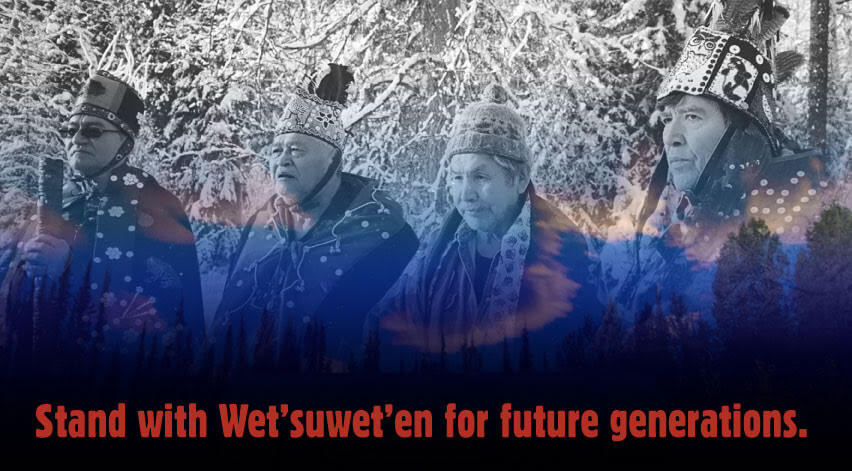
Two Wet’suwet’en Hereditary Chiefs have launched a legal action to hold the governments of Canada and British Columbia accountable to climate commitments for future generations.

A win for Wet’suwet’en is a win for us all. It would put in place safeguards so that projects and policies could only be adopted based on an assessment of climate impacts: for now, and for future generations.

Your Turn To Make A Move

Join hands with Wet’suwet’en and protect our planet. Donate to support their legal challenge.

Button Text

Learn More about the Challenge

A Charter Climate Challenge

Since time immemorial, the Wet’suwet’en have been stewarding and protecting their territories. Now, they are defending land, air and water for all of us with a historic and sweeping climate justice challenge.

Launched in February 2020, the two Likhts’amisyu Clan House Chiefs’ legal action is a challenge asking the Federal Court to declare that Canada has a constitutional duty to keep the country’s greenhouse gas emissions consistent with the Paris Agreement global warming limit of well below 2 ̊C above pre-industrial levels. The claim is focused on the inability of House members to safely and healthily live in their territories and practice their culture and way of life in a world threatened by climate change. The claim focused on the Charter rights — guaranteed to every citizen — relating to equality and to life, liberty and security of the person.

A Road Block from Canada

“The climate crisis is already hitting our House territories hard. You only have to look at the shrinking Hudson Bay Mountain glacier and count the salmon. If Canada is allowed to continue approving infrastructure for fracked gas projects on a 40-year timeline, our territories will become a wasteland before the project licenses expire.”

— Dini Ze’ Lho’imggin, Alphonse Gagnon

Wet'suwet'en Campaign: A Timeline

December 2023 – APPEAL GRANTED

Federal Court grants appeal by Wet’suwet’en in the Misdzi Yikh Charter challenge.

February 2023 – APPEAL OF JR DECISION

Federal Court hears Wetsuwe’ten’s appeal of the Nov 2020 decision.

April 2021 – JR APPLICATION DISMISSED

BC Supreme Court dismisses the Wet’suwet’en Application for a Judicial Review of B.C.’s decision to extend the environmental certificate for the Coastal GasLink pipeline.

December 2020 – WET’SUWET’EN APPEAL

Likhts’amisyu Clan of the Wet’suwet’en appeals the Federal Court’s decision to strike the Charter challenge.

November 2020 – FEDERAL COURT STRIKES

Federal Court strikes Likhts’amisyu Charter challenge as “not justiciable”, i.e. not appropriate for the court to decide.

October 2020 – JUDICIAL REVIEW

Judicial Review of BC’s granting of permit extension to Coastal GasLink heard October 1-2; at issue are multiple permit violations and a failure to apply recommendations of the Missing and Murdered Aboriginal Women and Girls Report.

February 2020 – RCMP RAID

Coastal GasLink crews attempt to re-start work in the Morice River area, resulting in RCMP enforcement action on Indigenous land protectors.

February 2020 – SOLIDARITY ACTIONS

Solidarity protests and actions erupt in support of Wet’suwet’en across the country: Kahnawake Mohawk community members south of Montreal erect a blockade on a CP rail line.

#WeAreTheStronghold concerts organized; $40k raised before COVID-19 shutdown cancels shows in Ottawa & Winnipeg.

January 2020 – EVICTION ORDER ISSUED

Dark House (Unist’ot’en) notifies Coastal GasLink of eviction from territory, citing violations of Indigenous law.

October 2019 – JUDICIAL REVIEW LAUNCHED

B.C. Environmental Assessment Office grants CGL an extension to their project permit, paving the way for construction in Wet’suwet’en territory.

January 2019 – INJUNCTION GRANTED TO CGL

BC Supreme Court grants CGL an injunction against land defenders in Wet’suwet’en territory.

Questions & Answers

What is the Wet'suwet'en legal challenge about?

The legal challenge is a constitutional and Charter of Rights challenge brought by two Houses of the Likhts’amisyu (Fireweed Clan) through their House Chiefs. The case is an ambitious, long-term legal challenge seeking a comprehensive overhaul of Canada’s environmental legislation to enable urgent action on climate change.

What is RAVEN's relationship with Wet'suwet'en?

In the fall of 2019, RAVEN was approached by two Chiefs of the Likhts’amisyu clan who requested support for their Constitutional/Charter challenge. RAVEN accepted the application and has entered into a formal agreement with the Wet’suwet’en Hereditary Chiefs. We are fundraising to provide access to justice for Hereditary Chiefs to pay the steep legal costs of pursuing this legal challenge.

If the Wet'suwet'en win, what would change?

With the Charter Challenge that is actively before the courts, Wet’suwet’en’s aim is to force Canada to bring carbon emissions to within the targets set by the Paris Agreement. A win would give Nations — and all Canadians — an instrument to hold governments accountable to climate commitments by forcing proposed fossil fuel projects to be evaluated according to their impacts on people’s rights to “life, liberty, and security of the person”.

What is the role of Hereditary Chiefs in Wet’suwet’en governance?

The Wet’suwet’en governance system, dating back for thousands of years, is based on Houses and Clans. Central to Wet’suwet’en government, law, social structure and world view is the Feast system. Dinï ze’ and Ts’akë ze (Hereditary Head Chiefs and Wing Chiefs of each House) draw their legitimacy neither through elections, nor through birthright alone (as in European monarchies) but through the Feast House process. Similar to the potlach, the Feast validates the chiefs’ authority and legitimacy according to Wet’suwet’en law. Before any Feast, there are many informal and semi-formal meetings at which ideas are introduced, discussed and a consensus built within the host House and among the other Wet’suwet’en Houses. The English term “hereditary leadership” doesn’t really convey the complexity of this highly participatory governance system.

Do Canadian Courts recognize Hereditary Chiefs?

Canadian law recognizes Indigenous governance in general and the Wet’suwet’en House and Clan system in particular. This was very clearly stated by the Supreme Court of Canada in its 1997 Delgamuukw decision. The Supreme Court of Canada described the system of Clans and Houses with Hereditary Chiefs as “the fundamental premise of both the Gitksan and the Wet’suwet’en peoples.”

Subsequently, the BC Supreme Court held, in Canadian Forest Products Inc v Sam, that “the Wet’suwet’en occupation and use of land is organized by the clan and house system upon which the law and essential social structure is ultimately based.” The BC Supreme Court went on to say that “each Wet’suwet’en chief has rights and responsibilities specific to the particular territory over which that chief is given a duty to protect. The rights and responsibilities are confirmed, coordinated, and directed to the common good, in other words, governed, through the feast,” which is “central to Wet’suwet’en society and government”.

The two legal challenges RAVEN is currently supporting were brought by Wet’suwet’en Hereditary Chiefs representing all Wet’suwet’en Clans.

What are the next steps?

Wet’suwet’en are currently awaiting trial for their Charter climate challenge, with a court date expected in 2024.

What happened to the other Wet’suwet’en case?

Acting in unity, Wet’suwet’en Hereditary Chiefs had, in an earlier case, sought a Judicial Review of a project extension for Coastal GasLink’s pipeline. They opposed the CGL permits granted by the B.C. Environmental Assessment Office (BCEAO). The action — which was also supported by RAVEN — argued that the B.C. Environmental Assessment Office had a duty to assess new evidence of the project’s harms, which in this case meant taking into account the findings of the Inquiry on Missing and Murdered Indigenous Women and Girls, which found direct links between extractive industries, “man camps” and increased violence against Indigenous women. The BCEAO was also required to take into account Coastal GasLink’s record of non-compliance with previous permit conditions. Unfortunately, this case was unsuccessful and is no longer active.

Where does the money go?

All the funds raised for Wet’suwet’en campaign go to Indigenous litigation. 85% of the funds raised go to Wet’suwet’en to fund their legal challenge. RAVEN receives 15% of campaign funds raised to sustain our operations.

What happens if we can't use the funds raised?

If a legal challenge is terminated, and the money raised exceeds the litigation expenses, we place the remaining funds into the Discretionary Litigation Fund. We use the money in the Discretionary Litigation Fund to add funds to any of our litigation campaigns that need extra funds for any reason (e.g., to respond to a Crown motion, or to commission additional expert reports).

Never Miss An Update

Campaign Media